

Skip Navigation

Posts
8
Comments
17
Joined
3 yr. ago

  • Yes, that is correct. We were using C++ and COM and didn't protect ourselves against accidental exception being thrown across the COM boundary. But it never happened. Except the one case CString::Load (or whatever the function name was) failed because of Office visual style had bug in it.

  • The main language of the app was English. The user could change it to German, French, Russian, Chinese, Spanish, etc. But sometimes the translation was not complete. Sometimes some plug-in was not translated. We used string IDs to identify various texts. Sometimes the ID pointed to the translated text, sometimes not, thus English version of that text was used instead.

    Also I reported the bug in the visual style to Microsoft. They refused to fix it and said something like "don't do that".

  • Win32 MFC desktop application, should be able to run continuously unsupervised for days or weeks. When I log in via RDP it crashed. Yes, just in that moment. In the end I figured it out.

    MFC supports multiple visual styles, such as classic Windows, few Office versions and few more. We used feature for loading (possibly translated) strings (resource) from various DLLs. First from a currently active plug-in DLL, if the string was not there, then from a sub-system DLL, if it was not there then from main EXE. Plus there was some logic about translation and fallback to English in case of missing or not up-to-date translation. The cause was in one of the MFC visual styles, it changed a global variable related to that string loading thing for a short duration of time, then changed it back. It was only in one of the styles and there was no need to change it, the code could just load the value and use it as a parameter to a function that needed it. Our code in a different thread failed to load a string and threw an exception. Cross a COM interface boundary. Every COM method is decorated by a bunch of macros our senior engineer didn't understand and was not willing to learn. One of the macros was noexcept. Thus an exception being thrown cross an noexcept boundary crashed our app.

  • No! One code point could be encoded by up to 4 UTF-8 code units, not glyph. Glyphs do not map to code points one to one. One glyph could be encoded by more than one code point (and each code point could be encoded by more than one code unit). Code points are Unicode thing, code units are Unicode encoding thing, glyphs are font+Unicode thing. For example the glyph á might be single code point or two code points. Single code point because this is common letter in some languages, and was used in computers before Unicode was invented, two code points because this might be the base letter a followed by an diacritic combining mark. Not all diacritic letters have single code point variant. Also emojis, they are single glyph but multiple code points, for example skin tone modifier for various faces emojis, or male+female characters combined into single glyph forming a family glyph. Also country flags are single glyph, but multiple code points. Unicode is BIG, there are A LOT of stuff in it. For example sorting based on users language, conversion to upper/lower case is also not trivial (google the turkish i).

  • You can always take a look how for example Windows 3.11 and earlier did it for their *.rtf file format and their "write.exe" editor / viewer / renderer (if you want to call it that way).

  • You have stack buffer out of bounds write. On line 52 you declare h an array of 70 unsigned ints. On line 57 you store reference to such array. Later, on line 35 you write out of bounds, one element past end of the array. The _SPR_history[i] writes to _SPR_history[70]. Created an issue: https://github.com/X64X2/sh/issues/1

  • Doesn't depend on programming language but something with visual debugger. You know that stuff when you can see current line of your source code highlighted, press a key to step into, step over and so on. You can see values inside your variables. You can also change your variables mid-run right form the debugger.

    Because you spend 20% of your time writing bugs and the other 80% debugging them. At least make it pleasant experience (no printf-style debugging).

    Back in the day I was using Turbo Pascal, Delphi, Visual Basic, C#, Java, PHP with Zend, Java Script, today I'm using Visual C++.

  • Programming @programming.dev

    32 MiB Working Sets on a 64 GiB machine

    randomascii.wordpress.com /2023/10/01/32-mib-working-sets-on-a-64-gib-machine/
  • Yes, I know this. It took me long time to figure this out. My entire life I focused on technical skills / programming / math / logic. As I deemed them most important for the job. I was like: "Hey, if you cannot program, why do you work as programmer (you stupido)?" Only few years ago I realized that even as programmer (as opposed to sales man) you really need those "meh" soft skills. And that they are really important and I should not call them "meh". I'm very good at solving problems, improving product's performance, memory consumption, discovering and fixings bugs, security vulnerabilities. But I'm very very bad at communicating my skills and communicating with people in general. I'm not able to politely tell people that theirs idea is bad, I just say "that's stupid". And I'm mostly/sometimes right (if I'm not 100% sure, I don't say anything), but the damage caused by the way I say it is often inreversible. That post of mine about the job interview and CV was half joke and half reality. I just freeze/stutter when I'm asked something that is obvious because it is written I my CV. I'm immediately thinking "Did he not received the CV?" or "Did he not read it?" "Why the fuck is he not prepared for the call? Why are we wasting time asking me what should be obvious because I sent it in advance?" I'm more robot than human. Put me in front of problem and forget to tell me that it is impossible to solve ... and I will solve it. But easy small talk ... disaster. Communicating what the problem really was ... disaster. Communicating how I solved it ... disaster. "It was not working before and now it works fine, what the hell do you want from me now?" Yes, I'm very bad in team, in collective. I didn't know the reason why, but since few years ago I know the root of the problem. It's not that everybody around me is stupid and don't know basic stuff (what I consider basic), but me unable to communicate with other humans.

  • The interview starts ... the interviewer asks me "Tell me about yourself." ... I respond "Did you receive my CV? I put all important details about me ... right there. What questions do you have about my past jobs?" The interviewer encourages me again to tell him about myself, my past projects, etc. ... Me: Awkward silence. ... Me to myself: Dafuq? Should I read the CV from top to bottom OR WHAT?

  • Yes, but (there is always a but) it does not apply if you implement off-line encryption. Meaning no on-line service encrypting / decrypting attacker provided data (such as SSL / TLS / HTTPS). Meaning if you are running the cipher on your own computer with your own keys / plaintexts / ciphertexts. There is nobody to snoop time differences or power usage differences when using different key / different ciphertext. Then I would suggest this is fine. The only one who can attack you is yourself. In fact, I implemented AES from scratch in C89 language, this source code is at the same time compatible with C++14 constexpr evaluation mode. I also implemented the Serpent cipher, Serpent was an AES candidate back then when there were no AES and Rijndael was not AES yet. The code is on my GitHub page.

  • C++ @programming.dev

    The Little Things: The Missing Performance in std::vector

    codingnest.com /the-little-things-the-missing-performance-in-std-vector/
  • std::vector::reserve + std::vector::push_back in loop is sub-optimal, because push_back needs to check for re-allocation, but that never comes.

    std::vector::resize + std::vector::operator[] in loop is also sub-optimal, because resize default-initializes all elements only to be overwritten soon anyway.

    This article's author suggests push_back_unchecked.

    I suggest std::vector::insert with pair of random access iterators with custom dereference operator that does the "transform element" or "generate element" functionality. The standard will have resize_and_overwrite hopefully soon.

    Moar discussion:

    https://codingnest.com/the-little-things-the-missing-performance-in-std-vector/

    https://twitter.com/horenmar_ctu/status/1695823724673466532

    https://twitter.com/horenmar_ctu/status/1695331079165489161

    https://www.reddit.com/r/cpp/comments/162tohr/the_little_things_the_missing_performance_in/

    https://www.reddit.com/r/cpp/comments/162tohr/the_little_things_the_missing_performance_in/jy21hgd/

    https://twitter.com/basit_ayantunde/status/1644895468399337473

    https://twitter.com/MarekKnapek/status/1645272474517422081

    https://www.reddit.com/r/cpp/comments/cno9ep/improving_stdvector/

  • Programming @programming.dev

    The Little Things: The Missing Performance in std::vector

    codingnest.com /the-little-things-the-missing-performance-in-std-vector/
  • Another alternative to C++ exceptions (instead of return code) is to use global (or thread local) variable. This is exactly what errno that C and POSIX are using or GetLastError what Windows is using. Of course, this has its own pros and cons.

  • C++ @programming.dev

    What's New for C++ Developers in Visual Studio 2022 17.7 - C++ Team Blog
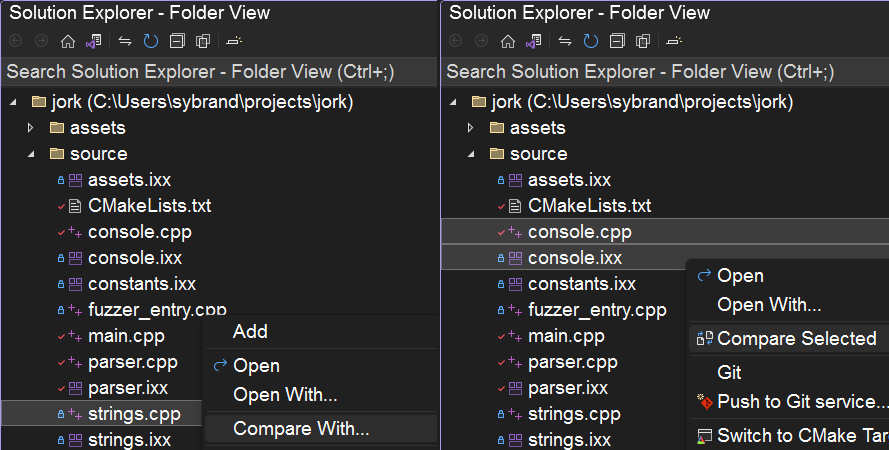
    devblogs.microsoft.com /cppblog/whats-new-for-c-developers-in-visual-studio-2022-17-7/
  • Java

    Jump
  • Makes sense, how would you represent floor(1e42) or ceil(1e120) as integer? It would not fit into 32bit (unsigned) or 31bit (signed) integer. Not even into 64bit integer.

  • C++ @programming.dev

    C++ AES-256 encryption at compile-time
    github.com /MarekKnapek/mk_clib
  • Programming @programming.dev

    AES encryption in C from scratch on web.

  • This is true in real world also, not only in computer world or programming world. Think of steam engine, it enabled sooo much progress in other fields. Also invention of lathe and precision measuring and engineering. Before that, invention of "simple machines" such as pulley, bolt/screw, windlass, lever. The same in math, physics, chemistry and so on.

  • Oversimplified:

    • You have your current OS, text editor, compiler.
    • You write code of the new improved OS using your current OS, text editor.
    • You compile the code (text file), compilation yields the new OS or the new kernel (binary file).
    • You replace (overwrite) your current kernel by the new kernel (current OS by new OS). This is possible, because while the OS is running it is in RAM not touching the disk.
    • You restart.
    • BIOS loads the new OS from disk to RAM and executes it.
    • tada.wav

    More questions:

    • How to update BIOS? Answer: The same.
    • How the first OS, text editor and compiler were created? Answer: The same. Using more primitive OS, text editor and compiler each step into the past. At the beginning there were toggle switches, punch cards, punch ribbon strips or similar.

    The same style of question would be: How to create a hammer if in order to create a hammer you need a hammer? How was the first hammer created? Answer: By more primitive hammer, or something that is no hammer, but almost works as a hammer.

    For more info read about bootstrapping compilers. Or trusting the trust by Ken Thompson.

  • C Programming Language @programming.dev

    Cryptographic hash functions calculator on-line.

    marekknapek.github.io /hash